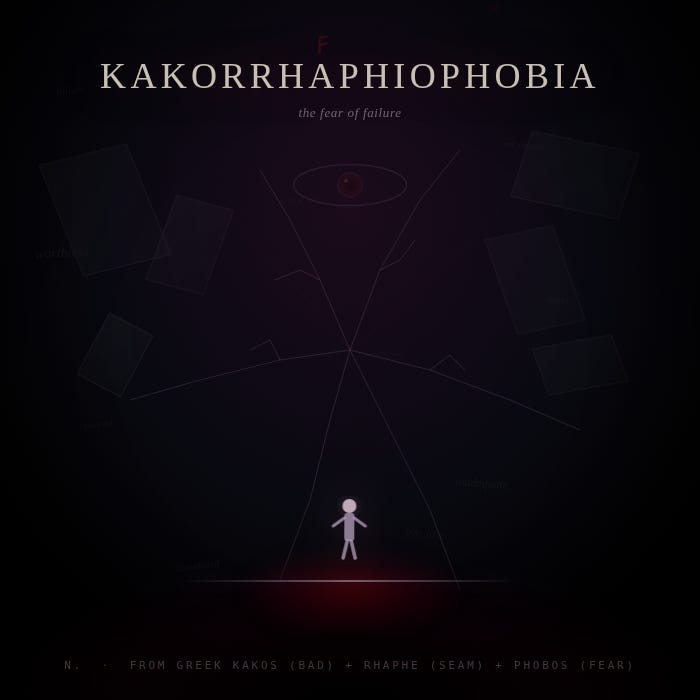
Kakorrhaphiophobia
The Word Leaders Are Afraid to Say

In 2003, a researcher named Brené Brown began asking people a simple question: What does vulnerability feel like in a professional setting?
The most common answer surprised her.
Not exposure. Not risk.
Incompetence.
The thing people feared most wasn’t being seen. It was being seen as someone who didn’t know.
Think about the leaders you’ve worked with. The good ones and the not-so-good ones.
Now ask yourself: which ones said “I don’t know”?
Garry Ridge, the long-serving CEO of WD-40, built one of the most remarkable learning cultures in American business. His explanation was almost disarmingly simple.
Three words, he said.
“I don’t know.”
Not because leaders should lack confidence. But because those three words do something that expertise can’t: they give other people permission to think.
Dave Cooper spent decades as a Navy SEAL instructor, watching teams succeed and fail under pressure. When researchers asked him what separated the best teams from the rest, he didn’t talk about talent or tactics.
He talked about what leaders said after things went wrong.
The best ones, he noticed, said something specific. Something most leaders avoid.
“I screwed that up.”
Four words. Enormous signal.
What those words communicate isn’t weakness. They communicate safety: the deep, behavioural kind that tells the people around you: we solve problems here, we don’t hide them.
Here’s what the research shows, again and again.
High-performing teams aren’t built on certainty. They’re built on something harder to manufacture: psychological safety. The shared belief that the group is a safe place to take risks, raise concerns, admit gaps.
And psychological safety doesn’t come from mission statements or values posters.
It comes from moments.
Small, specific moments where a leader, usually the most powerful person in the room, chooses honesty over performance.
There’s a name for the fear that prevents this.
Kakorrhaphiophobia. The fear of failure.
Most leaders carry a version of it: not the dramatic, obvious kind, but the quieter, daily kind.
The fear of not having the answer. The fear of looking uncertain. The fear that uncertainty itself signals weakness.
But here’s what the evidence suggests:
The leaders who suppress that fear, who perform certainty they don’t feel, gradually make the people around them less honest, less curious, less likely to surface the problems that actually matter.
The culture learns to pretend.
And pretending is expensive.
The good news is that the fix is surprisingly available.
It doesn’t require a restructure or a training programme.
It requires a leader, in a room, saying something true.
“I don’t know.”
“I screwed that up.”
Not as performance. Not as strategy.
As the first brick in the kind of culture where people actually learn.